Introduction: The Ethical Question Behind AI Recruiting
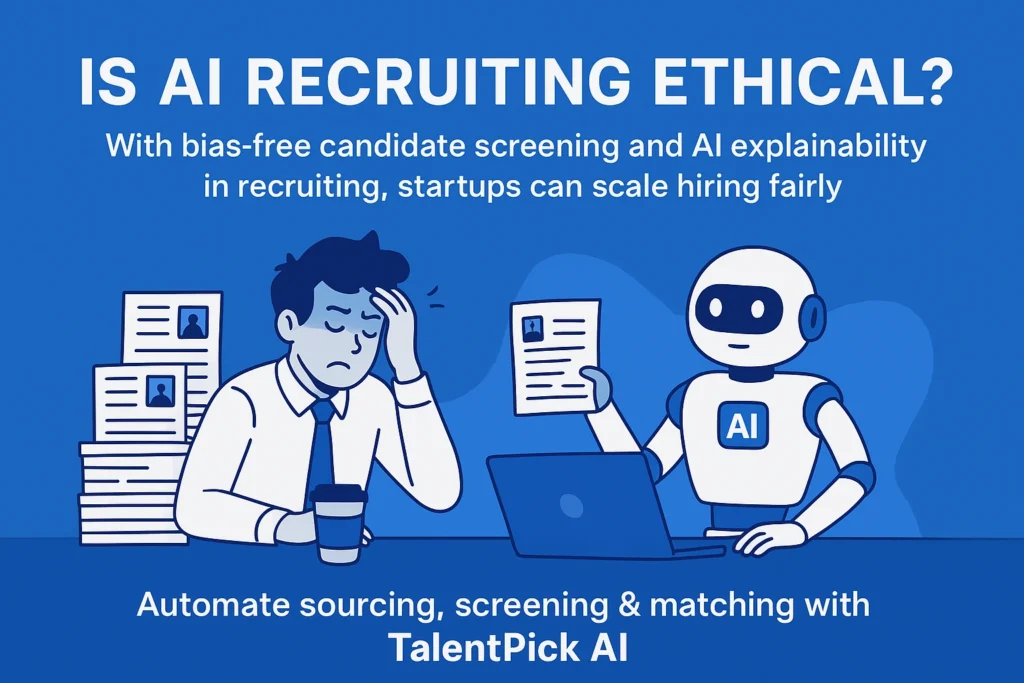
Artificial Intelligence (AI) is reshaping how companies hire from automated resume screening to predictive analytics that identify top candidates. Yet one question keeps surfacing: Is AI recruiting ethical?
As startups and HR teams increasingly rely on AI recruiting software, the concern about fairness, bias, and transparency grows. Can a machine truly make ethical hiring decisions? Or are we simply transferring human bias into algorithms?
The truth lies in how AI is designed, trained, and used. With tools focused on bias-free candidate screening and AI explainability in recruiting, startups today can make hiring more ethical not less.
1. The Ethics of Recruitment: Why It Matters More Than Ever
Recruitment isn’t just about filling positions it’s about building teams that shape a company’s future. Ethical hiring ensures every candidate, regardless of background, is treated fairly.
Traditional hiring, however, has often struggled with unconscious bias. Recruiters may often unintentionally favor candidates based on name, gender, school, or experience format. That’s where AI comes in.
AI recruiting software offers the promise of a data-driven, consistent, and fair hiring process. But only if it’s built and monitored with ethics in mind.
2. How Bias Creeps Into AI Recruiting
Before AI can reduce bias, we must understand how it can create it.
AI systems learn from data and if that data reflects human bias, the algorithm can replicate or even amplify it. For instance:
- If a company’s past hires were predominantly male, the system might “learn” to prefer male candidates.
- If resume data is imbalanced by geography or school, AI might unintentionally rank some candidates lower.
That’s why ethical AI hiring tools now include built-in bias detection, fairness checks, and model auditing features to ensure the system stays neutral.
3. The Rise of Bias-Free Candidate Screening
To counter bias, leading HR tech startups are deploying bias-free candidate screening tools.
These tools use anonymization techniques hiding names, photos, and personal identifiers so candidates are evaluated purely on skills and experience.
They also rely on structured scoring models to assess candidates consistently, eliminating the subjective “gut feel” that can introduce inequality.
For startups scaling globally, this is game-changing. Bias-free candidate screening allows them to:
- Reach more diverse talent pools
- Improve candidate trust and engagement
- Strengthening employer branding as an inclusive company
4. AI Explainability in Recruiting: Making Algorithms Accountable
Transparency is the cornerstone of ethical AI.
AI explainability in recruiting means every automated decision from resume ranking to candidate scoring can be traced and understood. Recruiters can see why a particular candidate was recommended or rejected.
This visibility prevents “black box hiring,” where decisions are made without clarity. It empowers HR teams to:
- Validate fairness in the algorithm’s logic
- Spot data issues early
- Communicate results confidently to candidates
When candidates understand how they’re evaluated, trust in the hiring process skyrockets.
5. The Human + AI Partnership: Not Replacement, but Enhancement
Ethical AI recruiting isn’t about removing humans from the hiring process; it’s about enhancing human judgment.
AI handles the repetitive, data-heavy tasks: resume screening, matching, scheduling, and initial assessments. Recruiters, in turn, can focus on human elements — interviews, empathy, and relationship-building.
This balance ensures:
- Faster yet fairer hiring cycles
- Reduced recruiter burnout
- More accurate candidate-role matches
As one Talent Pick AI principle goes: “AI should be the assistant, not the decision-maker.”
6. Regulations and Ethical Standards: The Global Shift
Governments and organizations are recognizing the impact of AI on hiring decisions. In the U.S., states like New York and Illinois have introduced laws requiring transparency and fairness audits for AI recruiting tools.
This means startups using AI recruiting software must choose partners that comply with these ethical frameworks, ensuring data privacy, non-discrimination, and accountability.
Ethics isn’t just good practice anymore; it’s becoming a competitive advantage.
7. How Startups Can Implement Ethical AI in Hiring
For startups embracing AI recruitment, here’s a practical roadmap:
- Choose transparent vendors – Opt for AI recruiting software that clearly explains its decision-making process.
- Audit algorithms regularly – Bias detection and correction should be continuous, not one-time.
- Train your team – Recruiters must understand how AI tools work to use them responsibly.
- Monitor diversity outcomes – Use talent analytics AI platforms to track how well you’re reaching diverse candidates.
- Prioritize AI explainability – Always be able to justify hiring decisions to both candidates and compliance teams.
8. The Future: Ethical AI as a Hiring Superpower
As we move toward 2025 and beyond, AI in recruitment will only grow more powerful integrating predictive hiring, conversational recruitment chatbots, and AI sourcing and matching software.
But with great power comes great responsibility. The companies that lead the next decade of hiring innovation will be those that blend tech efficiency with ethical clarity.
AI can’t replace human empathy. But it can empower recruiters to make better, fairer, and faster hiring decisions grounded in data, not bias.
Conclusion: Building a Fair Future with AI
So, is AI recruiting ethical?
Yes, when done right.
Ethical AI recruiting is about using technology to amplify fairness, transparency, and inclusion. With bias-free candidate screening, AI explainability, and ethical AI hiring tools, startups can scale without sacrificing integrity.
In the end, ethics isn’t just a compliance checkbox. It’s the foundation for building trust with candidates, with teams, and with the future of work itself.